Under the Bonnet
What's Actually Going On With Fuel (And What Isn't)


Words: Professor Ariella Helfgott and Robyn Green. Illustration: Stavroula Adameitis.
Starting Our Engines
A friend sent us a video last week. A commentator was ranting about how coal is the answer to our current fuel crisis. It convinced her, especially, she said, because it also pointed out that our leadership sucks. Fair enough. But coal makes electricity. This is a liquid fuel crisis. To use coal, or nuclear, to address this crisis you would need to electrify everything. And the same guy who was talking about coal was also against electric vehicles of all kinds, and anything else that would actually reduce the amount of liquid fossil fuel we need, and allow us to preserve what we have for the people who currently need it the most.
Then there are the people protesting outside energy supply companies. Their right to do so and their message are both important. But by itself, the focus only on the supply side won’t shift our demand-side dependence on liquid fossils one drop. It won’t get affordable EVs to people who need them. It won’t build the biofuels industry that could turn our human, agricultural and textile waste into fuel and fertiliser. And it won’t electrify the irrigation pumps that are burning through diesel on farms right now while we argue about it. As long as the dependence is locked in, those companies can basically laugh at the people out the front, which doesn’t make anyone feel or do better.
Some of the facts about how our energy system works that are being lost in the noise. This makes it hard for people to make sense of what’s going on right now. People are frustrated. People are worried. And they’re being fed bad information by commentators and politicians who are saying what they’re saying to get votes, profile or profit, not to help anyone fill their tank or get diesel to their farm.
This newsletter is about understanding what’s going on, what’s driving it, what’s coming next, and what we can do about it. It involves the discipline of sorting fact from spin so we can make better decisions, whether we live in the city or the bush, and regardless of who we vote for. Because in a crisis, the quality of the information we’re getting is just as important as the quality of the fuel supply.
How We Got Here
On 28 February 2026, US-Israel strikes on Iran triggered retaliation that effectively closed the Strait of Hormuz, through which roughly 20% of the world’s seaborne oil flows. The IEA called it the worst supply disruption in its 50-year history. Oil spiked above US$120 and is now volatile between US$90 and $110. China, Thailand and South Korea have restricted fuel exports to protect their own supply.
Australia imports about 90% of its refined fuel, mostly from refineries in China, South Korea, Singapore and Malaysia. Those refineries get 60-70% of their crude from the Middle East. So a war in the Middle East doesn’t just affect countries that buy Middle Eastern oil directly. It hits every country that depends on Asian refineries, and we are near the top of that list.
Australia used to have eight refineries. Between 2012 and 2021, five closed: Clyde and Kurnell in Sydney, Bulwer Island in Brisbane, Altona in Melbourne, and Kwinana in Perth. Asian mega-refineries could produce fuel more cheaply, and successive governments let ours go. In the same period, five Australian-flagged petroleum tankers were retired and never replaced. We are the only IEA member that has never met the mandatory 90-day fuel reserve requirement. This is a bipartisan, multi-decade failure. The structural hollowing predominantly happened under Coalition settings, but Labor has been in power since 2022 and has not materially improved reserve levels. Any party that claims this crisis belongs to only one side of politics is engaging in opportunism, not analysis.
Iran has rejected an earlier U.S. 15 point proposal and advanced its own demands. The path to resolution remains uncertain. This could be a short shock, a drawn out crisis, or a structural rupture that reorganises global energy trade. Each future demands a different response from Australia.
The actions that make sense if it’s protracted also make sense if it’s short. Building our resilience is not wasted effort if the crisis ends early. Failing to build it is catastrophic if it doesn’t.
The question is not just what happens in the Strait. It’s what we decide to do with the time we have.
The Fuel Gauge
As of the Prime Minister’s 30 March National Cabinet announcement, Australia held approximately 39 days of petrol and around 30 days each of diesel and jet fuel. Six of about 80 scheduled fuel shipments were cancelled or deferred, with replacements secured at higher cost and longer lead times. Over 600 service stations had run dry across the country, about 8% of the national total. Panic buying spiked demand by up to 50% in some areas.
The government’s response from 1 April: fuel excise halved from 52.6 to 26.3 cents per litre for three months, 20% of reserves released targeting regional areas, fuel quality standards relaxed for 60 days, and laws passed doubling penalties for price gouging to $100 million per offence. States and territories then agreed to forgo the GST windfall from higher fuel prices, funding an additional 5.7 cent per litre cut, bringing the total reduction to 32 cents per litre, or about $17.60 off a full tank.
Diesel is above $3.00 a litre in cities and higher in the regions. Petrol was running at $2.30-2.50 before the excise cut. The NRMA documented retailers raising prices before wholesale costs had even risen, with margins exceeding 50 cents per litre, and referred specific operators to the ACCC. Some of that is gouging. Some of it is the genuine global shock. Both are true.
Who’s hurting most? Regional and farming communities. Farmers are reporting two-week waits for diesel during the critical autumn planting window. Independent fuel distributors in country towns can’t get supply at terminals. This isn’t a city problem that trickles down to the regions. It hits the regions hardest and first, and the impacts of that will hit the cities down the track.
South Australia specifically: Every litre of liquid fuel is imported. Most of Adelaide’s supply comes through the Birkenhead terminal in Port Adelaide, with additional capacity at Largs North and Port Bonython near Whyalla. We receive most of our refined fuel from refineries in Asia. As of early April, 67 of our roughly 700 stations were reporting outages of at least one fuel type, and the number has been climbing. Every vulnerability listed above exists because we depend on imported liquid fossil fuel.
And yet, SA generates 74% of its electricity from renewables. Around 50% of SA homes have rooftop solar. We’re on track for 100% net renewable electricity by 2027. SA is approaching energy sovereignty on electricity and maximum vulnerability on liquid fuel. These are two completely different systems and the crisis hit before the transition between them is complete. Understanding this is the key to seeing through almost everything else being said about this crisis.
The Noise In The Back Seat
One of the most useful things foresight teaches is to not only look at what people are saying, but why they’re saying it, who benefits, and what they leave out. Every major narrative about this crisis performs a blame-allocation function first and a problem-solving function second, if at all. Here are some of the big ones.
“We should burn more coal / go nuclear”
Coal and nuclear make electricity. This is a liquid fuel crisis. They are two different systems. Unless you electrify the vehicles, machinery, and equipment that currently run on petrol and diesel, coal and nuclear are irrelevant to this crisis. And the people calling for more coal are almost always against the electrification. Even in the electricity system, nuclear plants take 10-15 years to build and cost significantly more per unit of energy than renewables with storage, according to CSIRO’s GenCost reports. Australia has no nuclear industry, no regulatory framework, and no trained workforce. Renewables can be built in 2-3 years and SA is already proving they work. This narrative confuses the two systems and proposes a solution to a problem we don’t have.
“We should just drill more and be self-sufficient”
Australia has about 1% of global commercial oil reserves. Even if we ramped up exploration today, new production takes 5-10 years to come online. Coal-to-liquids has never been commercially viable here. But here’s the deeper problem with this narrative that almost nobody is pointing out: even if we produced oil domestically, it would sell at the world price. That’s how commodity markets work. We know this because we already have a version of this experiment running. Australia is the world’s second-largest LNG exporter. We produce enormous amounts of gas. And it hasn’t helped household gas prices one bit, because the gas sells at international rates and our households compete with the global market for our own resource. Drilling more oil would reproduce exactly the same dynamic. The only fuel that’s genuinely sovereign, the only fuel whose price isn’t set by a war on the other side of the world, is the fuel you don’t need to buy on global markets at all: electricity from your roof, biodiesel from your waste, and a vehicle that doesn’t care what’s happening in the Strait of Hormuz.
“Renewables and EVs are to blame”
This is analytically incoherent. Renewables generate electricity. This is a liquid fuel crisis. Renewables policy did not close refineries: global economics did. The refineries were closed by multinational oil companies seeking higher returns from cheaper Asian facilities, under governments that prioritised short-term economics over strategic security. If anything, having more EVs powered by renewables would have reduced our exposure to this crisis. Australia's EV uptake was actively delayed by political scare campaigns.If Australia had pursued EV uptake at rates comparable to Norway or the Netherlands from 2019, we’d now be displacing an estimated 100 million litres of imported fuel per month. That’s the same volume the government is currently scrambling to add through relaxed fuel quality standards.
And no, EV chargers do not run on diesel generators. They plug into the grid. In SA, that grid is 74% renewable. Some people charge from their own rooftop solar.
“It’s just panic buying”
Both things are true at the same time. Panic buying does make shortages worse. And the underlying system is genuinely fragile. A system that can be tipped into crisis by a 7% supply disruption combined with predictable human behaviour is, by definition, not resilient. Calling for calm is appropriate. Using “panic buying” as the primary explanation for a structural vulnerability is not. You could say framing this only as a demand-side problem deflects from the structural exposure that hasn’t been fixed. You could also say some regional shortages were caused by farmers stockpiling on-farm diesel: a rational decision when you know you’re last in line for supply and your planting window doesn’t wait for geopolitics.
“Big Oil is gouging us”
Some gouging is documented and should be prosecuted. The NRMA has the evidence and has referred operators to the ACCC. But most of the price increase reflects genuine global wholesale movements. The more important structural question is: why does Australia’s competition framework allow retailers to raise prices before costs have risen? And why are independent regional distributors, who are victims rather than perpetrators in this, struggling to access fuel at terminals at any price? The narrative risks collapsing all price increases into a single “gouging” explanation when the reality involves multiple interacting factors.
“Energy lockdowns are coming / Great Reset”
The worry is about government overreach. Governments do sometimes use emergencies to expand their power, and it’s right to watch for that. But emergency demand management during a genuine supply crisis is not the same thing as authoritarianism. It’s how you protect ambulances, food distribution, and farming when there isn’t enough fuel to go around. Australia has had legislation for exactly this since the Liquid Fuel Emergency Act 1984. Fuel rationing was used during the 1970s oil shocks. This isn’t new.
The useful questions to ask are practical ones: are the proposed measures proportionate? Are they transparent? Are they time-limited? Do they have sunset clauses? Who’s making the decisions and who’s holding them accountable? These are the questions that actually protect your freedom. They’re also the questions that get drowned out when the conversation jumps straight to ‘Great Reset’ and ‘New World Order.’
It’s worth knowing that this framing isn’t emerging organically. The Institute for Strategic Dialogue has identified the ‘energy lockdown’ narrative as a direct continuation of the pandemic-era conspiracist playbook, now being amplified by conspiracy influencers with massive online followings and by pro-Russian social media accounts. These networks are, according to the ISD, ‘far more coordinated and organised’ than they were in 2020, aided by the rollback of social media content moderation. The people pushing this framing are not trying to protect your freedom. They’re trying to capture your anger.
Foreign interests are weaponising our crisis
The Australian government has confirmed that Iranian state media has been using AI to doctor Australian news graphics, fabricating reports that we have only 18 days of fuel when the real number is around 39 days. Pro-Russian accounts are amplifying footage of empty service stations to make the situation look worse than it is.
Why would they do this? Because panic is a weapon. Iran wants to demonstrate that the Hormuz closure is devastating Western economies, because that’s their leverage in negotiations: ‘look what we can do to your allies.’ If Australians panic-buy because they saw a fake graphic saying we have 18 days of fuel, that panic buying creates real shortages, which creates real footage of empty stations. We become participants in their information war without knowing it. Russia amplifies the same content because anything that erodes trust in Western governments serves their broader strategic interests.
Our fuel situation is genuinely serious. It doesn’t need exaggeration. The real numbers are concerning enough to demand action. Fabricated numbers serve the strategic interests of other nations, not Australian citizens.
But it’s not just Iran and Russia. Al Jazeera documented Australian political figures travelling to Washington to seek millions from the NRA and Koch Industries to influence Australian politics. The same networks of US fossil fuel money are linked to the Alberta secession movement in Canada, where separatists have held meetings with Trump administration officials. These are not conspiracy theories. They are documented, filmed, and on the public record. When someone tells you to be angry about fuel prices but to oppose the very things that would reduce your dependence on fossil fuels, it’s worth asking: whose interests does that actually serve? And whose money is behind the message?
From now on, every crisis we face will come with a disinformation campaign attached to it. That’s not paranoia, it’s just the world we live in now. The best protection is us: ordinary people who’ve learned to ask “where did this come from?” and “who benefits if I believe it?” before we hit share.
Two New Headlights
In all the noise and point scoring, two genuinely useful insights are getting missed. Neither is left or right. Both change how you see the crisis once you hear them.
One: Preserve fuel for the regions, by electrifying the cities.
Here’s a genuinely useful idea, and it doesn’t require anyone to change their politics:
Every car in the city that switches to electric is one less car competing for the liquid fuel that farmers, truckers, and regional communities actually need.
The fuel supply is tight. There’s only so much of it. If we electrify transport in the cities, where the charging infrastructure exists and the trips are short, we preserve more liquid fuel for the people and places that can’t easily go electric yet: farms, freight, remote communities, mining and aviation. This isn’t about making anyone feel guilty for driving a petrol car. It’s about triaging a scarce resource. Just like in a bushfire, you send the water where it’s needed most.
Factually, we’re all in this together. The fastest way to help each other is to shift what we can off imported fuel so there’s more for the things that can’t shift yet.
Yes it will take time, but it doesn’t just start with buying an EV. The fastest way to free up fuel right now costs nothing. Public transport, carpooling, working from home where you can, cycling and walking for short trips. Queensland already had 50-cent fares in place, introduced in early 2025, and they’re proving their worth as a crisis response. Victoria made all public transport free for the month of April. Tasmania went further: free buses and ferries for three months, from 30 March to 1 July. The PM himself urged Australians to use public transport. Every person on a bus or train is one less car burning imported fuel.
Then there’s the stuff already transitioning. SA is rolling out 60 new electric buses this year, bringing the fleet to about 81, around 8% of Adelaide Metro. All new buses in Victoria are electric. WA just hit 100, all built locally. NSW has over 220 in Sydney with another 151 on order. Every one of them runs on Australian electricity. Woolworths is transitioning its entire home delivery fleet to electric by 2030 and already has 60 electric trucks delivering groceries in Sydney. Coles has electric trucks delivering to stores in Perth and Sydney. Every grocery delivery that runs on electricity instead of diesel is food that keeps arriving regardless of what’s happening in the Middle East. That’s not a green aspiration. That’s food security.
For households, the shift is already happening. EV registrations in South Australia jumped 44% in March alone. Nationally, there are over 400,000 EVs on Australian roads and every single one of them didn’t queue at a petrol station last month. EV drivers are saving around $2,800 a year on fuel. Many of them, especially in SA, are charging from their own rooftop solar. Used EVs are now selling with 43% under $30,000. New electric hatchbacks are coming in under $32,000. CommBank reported a 161% lift in EV loan demand in March.
But let’s be honest about who this works for right now and who it doesn’t. In a cost of living crisis, the savings from an EV are real but the upfront cost is a genuine barrier. If you’re watching every dollar on groceries, a $30,000 purchase isn’t on the table even if it saves you $2,800 a year down the track. If you’re in an apartment block or parking on the street with no access to a power point, you can’t easily charge. If you’re off the main highways in regional Australia, public chargers are still thin on the ground. If you’re a tradie who needs a ute that can tow, the electric options are only just arriving and they’re not cheap. If you’ve just bought a petrol car on finance, you’re not switching any time soon. And if all you’ve heard about EVs is that they catch fire and leave you stranded, you’re not going to trust the hype.
None of these barriers are reasons to give up on the transition. They’re reasons to design it properly. Community charging infrastructure in apartment blocks and social housing so you don’t need your own garage. Fast chargers at regional shopping centres and truck stops, not just on the highway between Sydney and Melbourne. A growing used EV market where 43% are already selling under $30,000, and that will keep getting cheaper. Government incentives targeted at the people who would benefit most and can least afford the upfront cost. And honest, practical information from people who actually drive EVs, not scare campaigns from people who want to sell you more fossil fuel.
The transition has to be built for everyone or it will just reproduce the inequalities of the current system in a different form.
And on farms, the electrification that makes most sense right now is the equipment that doesn’t move: irrigation pumps, grain augers, cold stores. These are stationary, they can run on on-farm solar, and they burn through enormous amounts of diesel. Every pump that switches to solar is diesel freed up for the tractor that can’t switch yet.
The speed of all this is moving faster than most people realise. In China, electric heavy trucks went from 9% to over 20% of new sales in a single year. Fortescue is investing $4 billion in 360 electric haul trucks, 55 electric excavators, and 60 electric dozers for 2030. BHP and Rio Tinto are trialling electric haul trucks. Zenobē just announced $100 million to more than double the number of electric trucks in Australia to 2,000 by end of this year. The upfront costs are still high, supply chains are still global, and a surge in demand will stretch wait times. But the constraint is not technology. It’s policy settings, infrastructure build speed, and the investment signals that tell manufacturers where to send the vehicles.
Two: The fuel we need doesn’t have to come from oil.
This is the part most commentators skip entirely, and it’s where it gets genuinely exciting.
Some things need liquid fuel for the foreseeable future. You can’t electrify a 747. You can’t easily electrify a harvester in the middle of a paddock 200km from anywhere. Long-haul freight on remote routes, mining, aviation, shipping: these need molecules, not just electrons.
Those molecules don’t have to come from oil. And they don’t have to be imported from a war zone. They can come from our waste.
Australia sends hundreds of thousands of tonnes of textiles to landfill every year. We generate 7.6 million tonnes of food waste annually. Our farms produce enormous volumes of crop residue. Our abattoirs render 550,000 tonnes of tallow a year, most of which we export to the US and Singapore so they can make biodiesel from it. Our food outlets produce millions of litres of used cooking oil. Right now, we’re sending our biodiesel feedstock overseas and importing fossil diesel back. The technology to convert all of this human, agricultural, and textile waste into liquid fuel is proven. That’s not waste: it’s feedstock, and it’s ours.
Diesel made from these waste streams goes straight into existing diesel engines without modification. No new vehicle, no new infrastructure, no change at the bowser. Just different molecules in the same tank. A farmer running renewable diesel in the same tractor they’ve always used, made from Australian waste and agricultural byproducts, priced outside the global oil market - that’s genuine sovereignty. Bioenergy Australia found that replacing just 6% of petrol with bioethanol would be the equivalent of taking 730,000 vehicles off the road.
FITEC is an SA-based venture bringing proven waste-to-fuel technologies to market here. FITEC’s technology, which is already operating in Canada and other countries, can convert everything including agricultural residue, human waste and textiles into usable fuel particularly diesel.
Greenhill Energy is building a facility at Tailem Bend to take waste that would otherwise go to landfill and turn it into hydrogen and urea fertiliser for our farmers. They’ve partnered with Peats Soil and Garden Supplies, Solo Resource Recovery, and the City of West Torrens, and they’re already running pilot trials at Adelaide University’s Thebarton campus. All of Australia’s granular urea is currently imported. A plant in the Murraylands making urea from our own waste, powered by our own renewables, that can also produce jet fuel and hydrogen for trucks is sovereign capability in its purest form. Nicholas Mumford, Greenhill’s managing director, comes from farming bloodlines. He gets what regional SA needs.
The pipeline of projects is growing because the economics and the feedstock are both here.
The engines to use that hydrogen already exist. Diesel engines can be retrofitted to run primarily on hydrogen, with diesel used only as a pilot flame. UNSW Sydney has demonstrated this, and Rio Tinto is testing it for mining equipment. As hydrogen production scales up at places like Tailem Bend, this becomes another pathway for existing diesel fleets to shift off imported fuel without replacing the vehicles.
Sustainable aviation fuel (SAF) is being produced from waste oils, woody biomass, and captured CO2 combined with hydrogen. CSIRO has mapped enough Australian feedstock to supply almost 5 billion litres of SAF production. The RAAF is already trialling it. Rio Tinto has tested renewable diesel at its Pilbara iron ore operations. BP’s Kwinana Energy Hub, on the site of the old refinery that closed in 2021, is being rebuilt to produce SAF and biodiesel from biofeedstock. The refinery that was shut down in the name of economics is being reborn as something more useful.
Hydrogen can power fuel cells for heavy vehicles and is being developed for shipping. It’s further away from ready at scale, but the technology is real and Australia has massive renewable energy to produce it. Synthetic fuels, or e-fuels, combine hydrogen with captured carbon to produce liquid fuels that work in conventional engines. CSIRO describes the process as “hydrogen plus CO2 plus the magic of chemical engineering equals jet fuel, methanol, or diesel.”
The Future Fuels CRC spent seven years and 118 research projects working on exactly this: how to transition Australia’s energy networks to low-carbon fuels, including hydrogen, biogas, and synthetic fuels, using our existing 120,000km of pipeline infrastructure. The government announced $1.1 billion for a Cleaner Fuels Program in September 2025. Bioenergy Australia estimates that with the right investment, Australia could produce enough low-carbon liquid fuels to displace 19% of our fuel imports by 2040 and up to 47% by 2050.
SA is uniquely positioned for this. We have the renewable electricity to power the production. We have the agricultural feedstocks. We have the Tailem Bend project already in development. We have Port Bonython as potential hydrogen export infrastructure. And we have the one thing that makes all of it economically rational: we are 3,300km from the nearest refinery and completely dependent on imported fuel. For SA, making our own fuel from our own waste using our own energy isn’t idealism. It’s the most practical thing we could do given everything going on in the world.
The future isn’t “drill more oil or go without.” There’s a whole spectrum. Some of it is ready now: biodiesel, renewable diesel. Some is coming soon: SAF, Tailem Bend. Some is longer-term: green hydrogen, e-fuels. Electrify what you can to free up fuel for what you can’t. Build the alternative fuels so the things that genuinely need molecules have Australian-made molecules. And design it all so it works for everyone.
We need to be making our own molecules as well as our own electrons.
Where The Roads Go From Here
We’ve covered what’s happening and why, cut through the spin and looked at some big ideas. Now the question is, what happens from here?
Nobody can predict how long the Strait of Hormuz will stay effectively closed or heavily constrained. But we can think clearly about what the different possibilities mean for us. And what we choose to do matters at least as much as what happens over there.
The Big Uncertainties
How long does the disruption last? It could be short: resolved by mid-2026, oil back below US$90. It could be medium: six to twelve months, sustained pain, growing pressure for change. Or it could be protracted: a new normal. The actions that make sense if it’s protracted also make sense if it’s short. Building resilience is never wasted.
Do we treat this as a disruption to recover from, or as the push for a transformation we needed anyway? This is the biggest one. One path leads back to the status quo: patch it up, move on, hope it doesn’t happen again. The other recognises that the vulnerabilities this crisis exposed were already there and weren’t going away, and uses this moment to address them. Both paths have costs. Both paths have risks. The scenarios below show what each one actually looks like.
Does government lead or wait? Governments can do the minimum and step back. They can coordinate a response but avoid structural reform. Or they can push for structural change, knowing that every serious reform in energy policy attracts aggressive push back from multiple directions. Reform is politically expensive. But so is the next crisis hitting the same unreformed system.
Do communities pull together or pull apart? Crises can go either way. People can hoard, blame, and fragment. Or they can organise, share, and build. What we’ve seen so far is a mix: panic buying alongside genuine mutual aid, farmers forming diesel cooperatives, neighbours looking out for each other.
Which way it goes depends on more than policy. It depends on whether people are getting good information or being drowned in disinformation designed to make them angry. Whether the public conversation is about solving problems together or finding someone to blame. Whether media and social media reward solidarity or outrage. Whether people who are doing it tough feel included in the conversation about what happens next, or feel like decisions are being made about them without them. And whether the deep Australian instinct to look after your neighbour survives the pressure of everyone feeling squeezed at once, again.
These uncertainties combine into different futures. Here’s how they play out across four plausible scenarios.
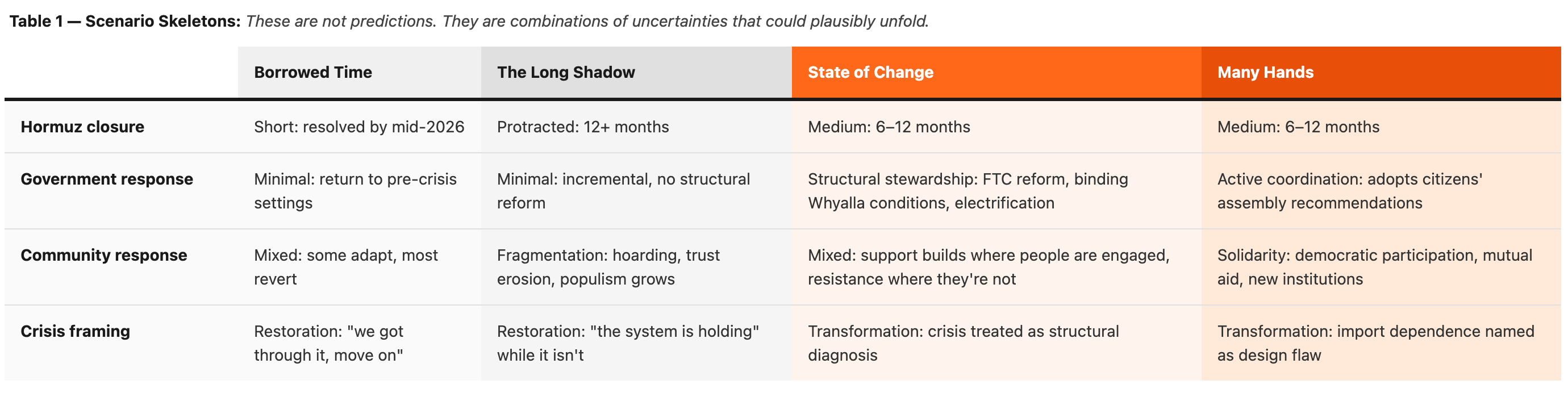
These are not predictions, they are combinations of uncertainties that could plausibly unfold.None of these is a prediction: they are tools for asking what could happen under different conditions. They allow us to explore which of these futures we are prepared for, prepared to let happen, willing to work towards, or towards preventing.
Scenario 1: Borrowed Time
The crisis passes quickly enough that nothing has to change. But the clock is still ticking.
A ceasefire by mid-2026. Oil drops back. Everyone exhales. The government restores everything to pre-crisis settings. The fuel taskforce is quietly disbanded. The next budget includes modest EV charging funding and some “resilience studies”. Nothing structural changes.
You notice it at first because petrol comes back under $2.00 and you stop thinking about it. The servo in your town reopens. The diesel deliveries resume. It feels like it’s over.
But nothing underneath has changed. Same import dependency. Same single terminal. Same 30-day buffer. The CFS volunteer who couldn’t fill the fire truck because the servo was dry? Same system. The farmer in the Mallee who lost tens of thousands in higher fuel costs and missed the sowing window doesn’t get that season back. The family in Elizabeth who spent hundreds more on fuel and groceries over three months doesn’t get that money back. The remote community whose generator ran low goes back to the “normal” that was never adequate.
The young couple waiting on their new build watches the quote climb by another $12,000 because PVC pipes went up 27% and concrete got harder to source. The builder they signed with six months ago goes under. They’re not the only ones: 3,596 builders went insolvent in 2025, before the crisis even hit. The national target of 1.2 million new homes was already behind schedule. It falls further behind. When the fuel price comes back down, the building costs don’t fully follow. They never do.
And everyone remembers. The farmer remembers that nobody came. The family in Elizabeth remembers choosing between fuel and food. The truckie remembers watching the price climb while politicians argued about whose fault it was. The frustration doesn’t disappear just because the petrol price comes back down. It sits there, waiting. And the next time someone stands up and says “they let it happen and they’ll let it happen again”, people listen, because it’s true.
And this crisis was just fuel. What happens when the next Super El Niño brings a fire season on top of a supply disruption? What happens when two systems fail at the same time? A system this fragile doesn’t get to choose when the next shock arrives.
The next Hormuz, the next pandemic supply shock, the next cyclone that takes out a terminal, or any combination of these at the same time. Same system, same exposure, same people bearing the brunt.
What you’d notice: Petrol prices come back down. Your town’s servo reopens. Everything feels normal. But the farmer next door is quietly selling up. Nobody’s built anything that would stop it happening again. And the anger hasn’t gone anywhere
Scenario 2: The Long Shadow
The crisis doesn’t end. The government waits. The fabric tears slowly.
The ceasefire talks collapse. Oil settles above $100. The disruption becomes the new backdrop to daily life. The government maintains its incremental approach: a bit more reserve, a bilateral deal here and there. No structural reform.
The system doesn’t collapse. It deforms. Slowly, unevenly, and always hitting the people with the fewest options first.
Diesel stabilises above $3.00. Your weekly shop costs $40 more than it did in February because freight costs are embedded in everything. The independent servo in your town closes because the importers ration supply to their contracted customers first, and the little guys are last in line. The next nearest fuel is 45 minutes away.
If you’re a farmer, the economics are impossible. Diesel at $3.30 makes some broadacre crops unprofitable. You know people who’ve switched to lower-input grazing. You know people who’ve walked off. The agricultural calendar doesn’t wait for geopolitics: if you can’t sow in autumn, you lose the season. There’s no catching up.
If you’re on a low income in the suburbs, it’s a slow grinding down. Fuel costs flow through to food prices. Bread goes from $3.50 to $5.20. The car fails its registration inspection and you can’t afford to fix it. Your commute stretches to 90 minutes each way on two buses, which there still aren’t any more of. Rent arrears accumulate. Nobody declares an emergency because the crisis isn’t dramatic enough. It’s just your life getting harder, month by month.
If you’re a builder or a tradie, the economics are brutal. Diesel for the truck, fuel surcharges on every material delivery, PVC pipes up a third, concrete in short supply because the quarries and batch plants can’t get diesel either. Fixed-price contracts signed six months ago are now loss-making. More builders go bust, fewer homes get built. The housing crisis and the fuel crisis feed each other: higher fuel costs mean higher construction costs mean fewer homes mean higher rents mean more people stretched mean less capacity to absorb the next shock.
If you’re in a remote Aboriginal community, the delivery truck comes every ten days instead of every five. The diesel generator runs low or fails. The health clinic rations electricity. A young man buys a solar panel online and installs it himself to keep the vaccine fridge running because the formal system hasn’t reached his community.
When government says nothing, honest people fill the silence with the worst explanation they can imagine. That’s not a character flaw. It’s how human beings are wired. And into that silence step the people with the simplest, angriest answers and the best-funded social media operations.
Trust erodes. The gap between what government says (”the system is holding”) and what you experience (”I can’t feed my kids fresh fruit”) becomes a chasm.
What you’d notice: Prices never quite come back down. The shop in your town closes. Your neighbour stops farming. The anger you feel is real, but nobody in power seems to be listening. The people who are listening are the ones with the simplest, angriest answers.
Scenario 3: State of Change
Government leads with courage. Where it brings people along, the reforms take root.
The crisis lasts eight months. Long enough to hurt, short enough to be politically manageable. What makes this scenario different is the response: a government that decides the structural diagnosis is clear, the tools exist, and the moment demands action.
Fuel Tax Credits reform begins: a five-year phase-down of the mining component, with agriculture fully exempted. The freed-up revenue goes to a national electrification fund. SA introduces the most aggressive EV and electrification incentives in the country, doubled for low-income and regional energy users. All new buildings are required to be all-electric from 2027. New developments must show that residents can access shops, schools, and health services without needing a car, so we stop locking in car dependence with every new suburb we build. The Whyalla steelworks is sold with binding conditions for hydrogen-ready design. Port Bonython gets serious hydrogen funding. Alternative fuel projects like Tailem Bend get fast-tracked. Developments that drive solutions are given special status, and fall within the Coordinator General’s remit.
The reforms work because they’re designed with the economics, not against them. In SA, where electricity is cheap and solar is abundant, running an EV costs a fraction of running a petrol car. The transition accelerates because it saves people money, not because it asks them to sacrifice.
If you’re a farmer, you get the agriculture exemption. Your fuel costs don’t increase. Regional EV rebates bring a used electric vehicle within reach for your family’s second car. A neighbouring farmer is running an electric irrigation pump demonstration and the results are credible because a farmer produced it, not a bureaucrat. And the biodiesel goes straight into your tractor without modification.
If you’re on a low income in Elizabeth, this is the scenario where things actually get better. Transport costs drop from $60 a week to under $10. A community battery goes in at the housing trust. A community energy model like the Shine Hub program, where neighbours share solar through a virtual grid, reaches your street. For the first time, an energy policy feels like it was designed for someone in your postcode, not just for someone in Burnside.
If you’re a mine worker, you’re retraining on battery systems and high-voltage equipment. The electric transition at Olympic Dam creates higher-skilled, higher-paid roles. It’s not frictionless. Some older workers take early retirement. But the new jobs are better than the old ones.
If you’re in a remote Aboriginal community, solar-plus-battery microgrids cut diesel consumption by 75%. In the communities where government partnered with local organisations on design, the programs build capability and pride alongside the infrastructure. In the ones where the rollout was centrally managed without local input, the technology arrived but the relationship didn’t. The gap between those two experiences is this scenario’s clearest lesson.
The government uses the crisis to accelerate modern methods of construction: modular and prefabricated housing that reduces on-site diesel use and exposure to volatile material costs. Government mega-projects are sequenced so they’re not competing with private housing for the same scarce materials and labour at the same time. Electrification of construction equipment gets the same incentives as transport electrification. The crisis makes visible what was already true: a construction industry built entirely on diesel and petroleum-based materials is a construction industry hostage to the same geopolitics as the fuel supply.
Government can set the direction. It can reform the tax system, fund the infrastructure, set the building codes, and fast-track the projects. But there are limits to what any government can achieve from the top down. It can build the charger, but it can’t make your neighbour trust it. It can fund the community battery, but it can’t create the community that uses it well. It can exempt agriculture from fuel tax reform, but it can’t rebuild the relationship with regional communities that decades of neglect have damaged. Where the government engages communities, consults, listens and co-designs, the reforms take root and build genuine support. Where it moves too fast to listen, the technology lands but the trust doesn’t. Courage without listening is just another form of imposition.
Crises create political openings that don’t exist in normal times. Changes that seem impossible before a crisis become obvious during one. The question is whether government uses that opening to make lasting structural reforms, or lets it close. SA has that opening now. But only if government leads and listens at the same time.
What you’d notice: Your power bill drops. Your neighbour buys a used EV. The bus to town is electric and quiet. The new development going up down the road has a shop, a GP clinic, and a bus stop built in from day one. Your teenager can get to school without you driving them. It’s a small thing but it changes the shape of your week. The farmer down the road is trialling an electric pump and running biodiesel in the tractor. It’s not perfect. But things are actually, tangibly getting better. And it feels like someone finally gave a damn.
Scenario 4: Many Hands
South Australians decide their energy future together.
The crisis lasts seven months. What makes this scenario different isn’t the external conditions. It’s what happens inside SA.
A coalition of trusted SA organisations A coalition of organisations, from the SA Farmers Federation to the Conservation Council, the RAA to the United Workers Union, Business SA to Community Foundations SA, the Aboriginal Lands Trust to the Country Women’s Association, jointly proposes an SA Energy Assembly: 120 randomly selected South Australians, stratified by region, age, income, and cultural background, tasked with answering one question: “How should South Australia secure its energy future so that no South Australian is left vulnerable?”
The Assembly runs over eight weekends. Participants hear from engineers, farmers, economists, climate scientists, Aboriginal elders, and fuel company executives. They visit Birkenhead terminal, a wind farm, the Hornsdale battery, and a community on the APY Lands. They argue. They listen. They debate. They find common ground in places nobody expected. A retired mechanic from the Barossa and a young renter from Salisbury end up co-authoring a recommendation on community energy. A farmer from the Murray Mallee changes her mind about EVs after hearing from an EV driver about their rooftop solar. An Aboriginal elder from the APY Lands changes how everyone in the room thinks about what “sovereignty” means when it comes to energy.
Their recommendations are more ambitious than the government expected and more pragmatic than the activists hoped. A commitment to reduce liquid fuel import dependence by 70% within fifteen years. A Community Energy Fund with governance shared between government and community boards. Free off-peak public transport, a recommendation that came directly from a cleaning worker who testified about choosing between fuel and food. A First Nations Energy Sovereignty program with Aboriginal community boards controlling design, procurement, and maintenance. And one that gets the most applause from participants across every demographic: no new residential development approved unless residents can reach essential services without a car.
People who were part of the process, or knew someone who was, feel invested in the outcome.
If you’re a farmer, a farmer’s testimony on the Assembly directly shapes the agricultural transition stream. Equipment loans for electric machinery and on-farm solar are available within weeks, governed by people who understand farming. Local councils form mutuals to collectively invest in waste-to-fuel and community energy infrastructure, achieving scale that no single council could reach alone.
A builder from the northern suburbs testifies to the Assembly about losing his business to fixed-price contracts in a volatile market. His testimony shapes a recommendation for contract reform that protects both builders and buyers during supply shocks, and for government mega-projects to be sequenced so they’re not competing with private housing for the same scarce materials and labour at the same time.
If you’re on a low income, the free off-peak public transport exists because someone like you stood up and said what life actually costs. Community battery and solar infrastructure has a governance board, and you sit on it. The Shine Hub model, or something like it where neighbours share solar through a virtual grid accessible via an app, rolls out across social housing. You’re not just a recipient of policy. You’re a participant in the decision.
If you’re a mine worker, the transition is less jarring because the citizen mandate gives it broader legitimacy. Someone you know was part of the process. It’s harder to dismiss something your cousin helped design.
If you’re in a remote Aboriginal community, this is where it’s most different from every other scenario. The First Nations Energy Sovereignty program is designed by your community, procured through Aboriginal-owned businesses, and maintained by people trained locally. Elders sit on steering committees. The solar arrives, and so does genuine governance authority. The technology and the power transfer together.
But Many Hands has its own honest limitation. Citizens can deliberate, recommend, and build legitimacy. But they can’t reform the fuel tax system. They can’t fund the hydrogen hub. They can’t set building codes or fast-track state-significant projects. They can’t redistribute resources from where they’re concentrated to where they’re needed. That takes state level leadership with the courage to act and the political will to wear the pushback. The Assembly can tell government what the community wants and give it democratic cover to act. But without legislation, funding, and regulatory reform behind the recommendations, they stay on paper. Community voice without state action is limited in scale. State action without community voice lacks the trust and ownership to sustain change. Both are needed for true transformation.
But even the best policies only create the conditions. They don’t change our behaviour by themselves. That part is on all of us. Every household that switches, every business that adapts, every community that organises, every farmer that trials something new. Government can open the door. We have to walk through it.
The transition in Many Hands is slower on some metrics. Fewer EVs in the first year. Less infrastructure in the first 18 months. But it survives two changes of government without being reversed, because no party campaigns on unwinding something that 120 randomly selected citizens designed and community and industry are actively embracing. The democratic process is the insulation against political whiplash.
The farmer who cast a protest vote in 2026 doesn’t need to in 2040. Not because she changed her politics, but because the grievance was addressed.
Adelaide starts to feel like what one urban planner described as “not a big city but a collection of villages”: each area with its own local services, its own energy governance and its own connection to the food and fuel systems that sustain it. The change is slower but it feels like yours.
What you’d notice: Someone you know got picked for the Assembly. Your town has a community energy board. The new estate on the edge of town has a walking path to the shops and a bus that actually comes regularly. Your council is part of a mutual that’s investing in a local waste-to-fuel plant. The changes are slower but they feel like yours. And when the government changes, the reforms don’t get ripped up, because they belong to the whole community, not to a faction.
What The Mechanic Would Tell You
Scenarios are not predictions; they are alternative plausible futures that help us perceive and ask important strategic questions.
The seeds of every one of them exist right now: the pressure to go back to normal, the slow grinding down that’s already happening in regional towns, the government decisions that could go either way and the community organising that’s already starting in places nobody’s paying attention to. The point of scenarios isn’t to pick the one you think will happen and plan for it. Planning for one future in an uncertain world isn’t resilience, it’s gambling. The point is to learn from all the scenarios and make better decisions today because you’ve thought more broadly about what’s possible.
Here’s what these four futures, taken together, actually tell us.
The status quo is not the safe option.
Borrowed Time feels like a relief. But it’s the scenario where nothing is learned, nothing is built, and the next crisis hits the same system. The Long Shadow shows what happens when that same inaction meets a crisis that doesn’t end quickly. The “safe” choice, doing nothing structural, is actually the highest-risk path. It just doesn’t feel like risk because the damage is slow and falls on people who aren’t in the room when decisions get made.
The transition isn’t all-or-nothing.
Liquid fuel doesn’t disappear overnight in any of these scenarios. Some things will need molecules for years to come. The shift is from an unmanaged, total dependency on imported fossil fuel to a managed, shrinking dependency where we electrify what we can, make alternative fuels from our own waste for what we can’t, and hold genuine reserves for what remains. Biodiesel that goes straight into existing tractors fills the gap while electric alternatives mature. The point isn’t perfection. It’s moving from a system where everything breaks when one shipping lane closes to a system with multiple sources, multiple technologies, and genuine redundancy. That’s resilience.
Our interests are more connected than our politics suggests.
EVs in the cities preserve diesel for the regions. Food production in the regions feeds people in the cities, and the food needs to be able to get there. Farmers can’t build charging networks. Governments can’t grow food. Cities can’t function without the regions and the regions can’t transition without investment and support. The urban-regional divide is real in people’s experience but false as a description of how the system actually works. We are one system. What helps one part helps the others. What damages one part cascades.
Neither government, communities, nor industry can do this alone.
Government can set direction, fund infrastructure, and reform the systems that only government can reform, but it can’t sustain anything it doesn’t have social licence for. Industry can innovate, invest, and scale solutions faster than any other actor, but it follows the signals that policy and markets send. Communities can organise, build legitimacy, hold both government and industry to account, and act and embrace new options, but they can’t reform tax systems or fund infrastructure at the scale that’s needed. The scenarios where things get better are the ones where all three move together.
The transition has to be designed for equity or it will deepen the divides it’s supposed to heal.
In every scenario, the question isn’t just “does the technology arrive?”: it’s “who does it arrive for first, and who gets left behind?” When electrification reaches Burnside before Elizabeth, when chargers appear on highways before regional shopping centres, when incentives go to people who could afford to switch anyway, the transition becomes another thing that works for the comfortable and not for the stretched. The scenarios that work are the ones that start designing with the people who need it most.
The fuel crisis is also a housing crisis.
Construction runs on diesel at every stage: quarrying, manufacturing, transport, on-site equipment. Many building materials, from PVC pipes to bitumen, are literally made from petroleum. When fuel prices spike, construction costs spike, builders on fixed-price contracts go bust, and fewer homes get built. The HIA estimates this crisis could add $8,000 to $15,000 to the cost of a new home, on top of prices that have already risen 40% since 2020. Australia’s target of 1.2 million new homes was already behind schedule. This is what cascading system failure looks like: a war in the Middle East makes it harder for a young couple in Adelaide to afford a house. The connection is invisible until you trace the diesel through every link in the chain.
Demand transformation is the missing piece.
Almost every narrative in the public conversation is about supply: where does the fuel come from, who’s to blame for the shortage, how do we get more of it. But the deeper shift is on the demand side: how do we stop needing so much imported liquid fuel in the first place? Electrify what we can. Build biofuels for what we can’t. Design cities and towns where people have genuine choices about their mobility. Every kilometre driven on Australian electricity or Australian biodiesel is a kilometre that doesn’t depend on the Strait of Hormuz.
Disinformation is now a permanent feature of every crisis.
In Borrowed Time, the information void after the crisis passes gets filled with “it wasn’t that bad” and nothing changes. In The Long Shadow, the gap between official messaging and lived reality gets filled by the people with the simplest, angriest answers and the best-funded social media operations. In the scenarios that work, good information and genuine democratic participation are what make the reforms possible. The quality of our public conversation is infrastructure, and just as real as a pipeline or a charging network. It has to be built and maintained or it degrades.
The dividing line isn’t left versus right.
It’s not city versus country. Everything that runs on Australian electricity, Australian biodiesel or Australian solar is sovereign. Everything that runs on imported fossil fuel is exposed. Even local fossil fuels are exposed to global market fluctuations. The transition from exposed to sovereign is the work. And it’s work that benefits everyone, not one side at the expense of the other.
The decisions that matter most will be made in the next few years, not the next few decades.
Looking back from any of the better futures, the decisions that made the difference were mostly made between 2026 and 2030. Whether the crisis was treated as a structural diagnosis or a temporary disruption. Whether the transition was designed for equity from the start. Whether democratic governance was built alongside the infrastructure. Whether we had the courage to be honest about what failed and why. The window for these decisions is open now. It won’t stay open forever.
We’ve done hard things before.
SA went from zero renewable electricity to 74% in less than two decades. We built the Hornsdale Big Battery when the world said it couldn’t be done. Farmers have adapted to drought, fire, flood, and market collapse for generations. Regional communities have organised, improvised, and looked after each other through every crisis that’s hit them. The capacity is there. The question is whether we use it, or wait until we have no choice.
The actions that make sense in State of Change and Many Hands make sense across all Hormuz closure scenarios.
The actions that make sense in State of Change and Many Hands also make sense in Borrowed Time. Because when the next crisis hits, and it will, we’ll either have built something stronger or we’ll be standing in exactly the same spot, having this exact same conversation, wondering why nobody did anything last time.
Who’s Driving?
This work started with a conversation between people who couldn’t sleep properly. Robyn Green, with a long career in emergency management, community engagement, intergovernmental relations and public policy, and Ariella Helfgott, with a career in strategic foresight, systemic intervention, strategy and policy. We both felt this moment was critical, and that the gap between the information many people are getting and the information they need to make good decisions was dangerous. We saw the need to maintain two speeds: we need to navigate the here and now, while shaping a new future that makes us collectively more resilient. We did this work for free, because the stakes are too high and the information environment is too broken to wait for someone to commission it.
So we convened a bigger conversation. We spoke with and brought together people from transport planning, urban design, food, water, energy and health systems, deliberative democracy, local government, regional development, housing, construction and emergency management. We ran a rapid foresight process at Lot Fourteen. We mapped critical uncertainties, generated scenarios, stress-tested them, and ensured we cross-checked every fact against at least two independent sources.
The scenarios in this newsletter are summaries of much deeper analyses. The full scenario report, the workshop findings, and the detailed evidence base are available on request. If you want them, or if you want to use any of this in your own community, workplace, council, or organisation, please get in touch via hello@safuturesagency.com.au or robyn@emeraldskysolutions.com.au
But this isn’t really about our analysis. It’s about your conversation.
Everyone we spoke to while putting this together, the farmers, the transport planners, the emergency workers, the mayors, the pharmacists, the builders, the people running waste-to-fuel startups out of sheer stubbornness, they all said some version of the same thing: we know more than we think we do, and we’re more capable than we’re being given credit for. The problem isn’t that people don’t care. It’s that the public conversation has been so polluted with spin and blame that it’s hard to think straight. It’s hard to see a way through.
The most important conversations about this crisis aren’t happening between experts or politicians. They’re happening between you and your neighbour. Between the farmer and the city cousin. Between the tradie who’s furious about fuel prices and the EV driver who hasn’t queued at a servo in two years. Between the person who’s scared and the person who has information that might help. Between people who vote differently but want the same thing: to know their family is going to be OK.
If you found something in here that surprised you, share it. Not to win an argument. To start a conversation.
Some questions worth sitting with:
What would it take for you to feel genuinely secure about energy in this country? Think about the next few weeks and months. Then think about the next ten years.
Who in your life sees this differently from you, and what would it take to have an honest, constructive conversation with them about it?
What’s one thing you could do this month, not to save the world, but to make your own household or street or town a little less exposed?
We don’t all have to agree on the answers. We do have to be able to talk to each other honestly about the questions. That’s harder than it sounds right now, when every issue gets turned into a fight and every conversation gets sorted into teams. But it’s the thing that makes every other solution possible.
If you found this useful, send it to someone who’s frustrated or confused about the fuel situation. Especially if they see things differently from you.
That’s what it’s for.